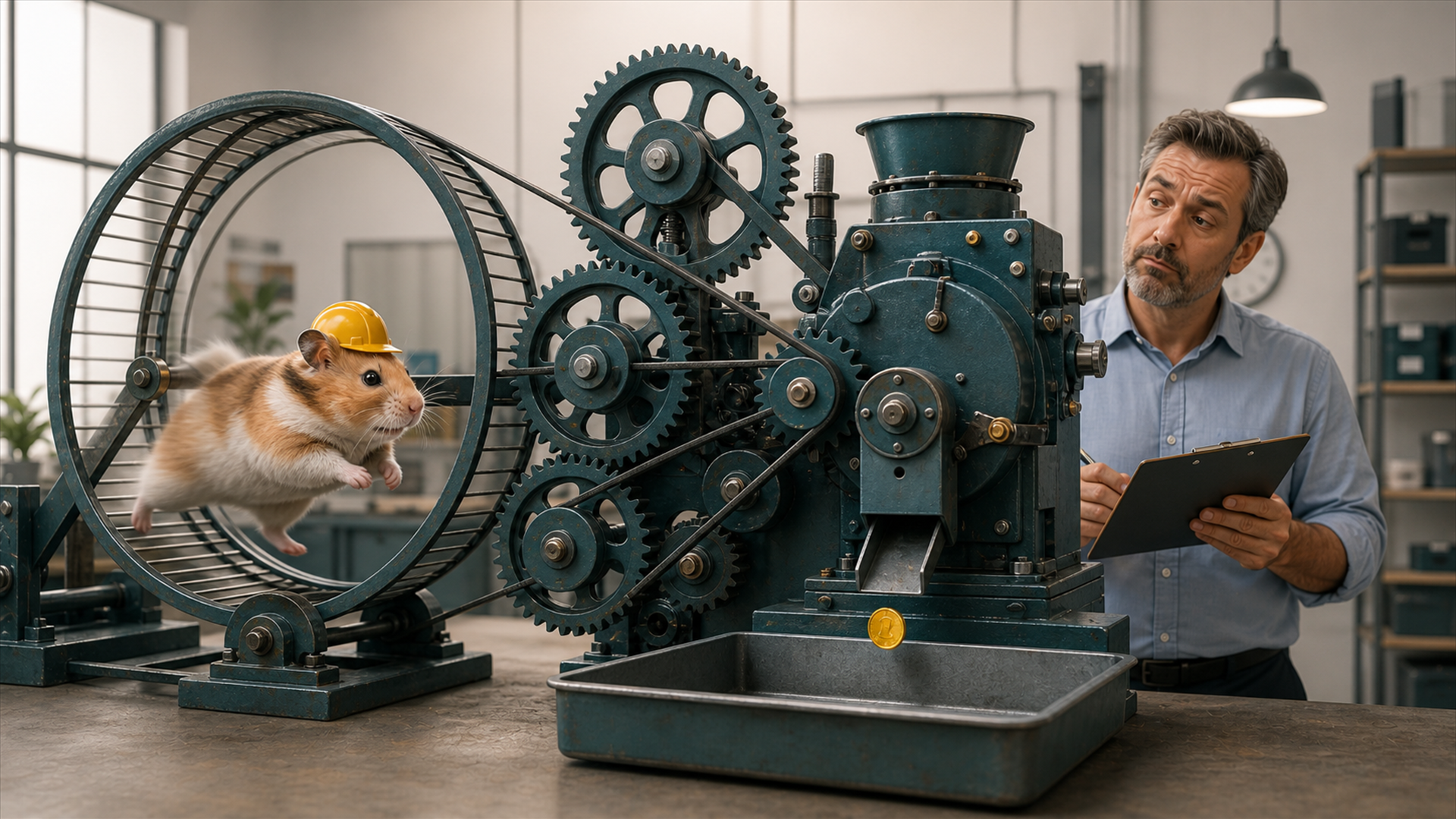
Busyness is visible. Profit is less sentimental: it rewards useful output, not motion.
Orders are coming in. People are busy. Overtime is up. Managers spend their days jumping from one problem to the next.
Then the monthly figures arrive. The profit is poor.
This surprises people because a busy business looks healthy. It may be healthy. It may also be using far too much work, material and management time to produce the result.
A hamster looks busy too. This is not a criticism of hamsters. They do not claim to be running a business.
The accounts show the bill, not the cause
A profit leak does not appear in the accounts as “money lost because our planning is a mess”.
You see overtime. Urgent freight. Credits. Scrap. Stock. Repeat visits. Work done twice. Orders invoiced late.
The cause may have started much earlier.
One poor promise from sales becomes a rushed order. Purchasing pays extra. Operations changes the plan. A supervisor moves people around. Quality gets squeezed. The customer receives the order late anyway.
Each cost may sit in a different report. The whole thing began with one promise nobody checked.
Good people hide bad systems
This happens all the time.
A planner keeps a private spreadsheet because the main one cannot be trusted. A supervisor checks every order because handovers fail. An experienced worker knows which instruction to ignore if the job is to leave on time.
These people are not the problem. They are keeping the place going.
But their extra work hides the fault. Management sees the completed order. It does not see the reminders, checks, calls and small rescues behind it.
After a while, everybody calls this normal.
It is normal in the sense that it happens every day. That does not make it good.
Put output beside input
Cost on its own tells only half the story.
More overtime can be fine if it produces enough good output. More material can be fine if sales grow and waste stays under control. Another employee can be the right answer if the extra work pays for that person.
So put the two sides together.
What came out? Saleable units, completed jobs, invoices, deliveries or another result that matters.
What went in? Paid hours, overtime, material, machine time or outside services.
Then look at the trend. Three years if you have it. Several months in more detail where needed.
If input went up by twenty per cent, what did you get for it?
There may be a sound answer. Product mix changed. Quality improved. A new contract needed extra work at first. Fine. Show it.
If nobody can explain the gap, look closer.
How do we cash the cheque?
Once a leak is fixed, the benefit comes in one of three ways:
- more output or better quality from the same resources;
- the same output from fewer resources; or
- some of both.
This choice matters. Saving ten hours does not put money in the bank if the ten hours are simply lost inside the working week. Management must decide what those hours will do instead.
This is where the upside comes in. Freed time may support more sales, maintenance, training, faster service or less overtime. Name the benefit. Give it an owner. Check that it happened.
Otherwise the cheque remains in the drawer.
What has ISO 9001:2026 got to do with this?
The new edition is due in September 2026. It gives clearer attention to risks, opportunities, leadership and the facts used for decisions.
That is useful, but only if it reaches the work.
A company can pass an audit and still depend on secret spreadsheets and daily rescue work. The certificate cannot see those things. Managers can, if they ask and people tell them the truth.
The move to ISO 9001:2026 is therefore a good time to check how the business really runs. Procedures are only part of it.
I can help with that move as part of a Profit Leak Diagnostic or as a separate review. The starting point is the same: facts first.
For this week, choose one output and one main input. Put them on the same page.
If the business is working harder but getting no more out, ask where the work went.